A Retired Village Herbalist Leaked The Forgotten Stomach Recovery Ritual Nigerian Adults Used Before Omeprazole Became The Only Answer

If you are reading this, I think I already understand something about your story.
Because it was mine for a long time too.
The ulcer pain that wakes you before your alarm.
The hunger you are afraid of because you know what happens when you wait too long between meals.
The way certain foods have become your enemies, one by one, until the list of things you cannot eat is longer than the list of things you can.
The acid tablet that works for three weeks.
Then stops.
Then you buy another pack. Then another. And somewhere between the third and fourth prescription cycle, you stop telling people about it because there is nothing new to say.
"Still managing it" becomes the only answer you have.
That is not managing. That is surrendering.
I know this because I spent years there myself.
Years of antacid cycles that wore off. Years of specialist visits that produced the same advice. Years of probiotics that helped for a season and then quietly stopped doing anything at all.
And then one afternoon in a village in Imo State, everything I thought I knew about stomach recovery changed.
⚠️ Let Me Be Direct With You, Brother
The ulcer does not wait for you to find time to deal with it. It disrupts your work, your sleep, your eating, your presence at the dinner table with your family. Every month you spend managing symptoms instead of recovering is another month of productivity quietly lost and money quietly spent on solutions that do not reach the root of the problem.
You deserve more than symptom management. And there is a reason your acid tablet keeps wearing off.
If you are tired of cycling through antacid packs that manage but do not resolve...
Read every word I am about to share with you.
Because what I discovered on that afternoon changed the direction of my stomach health permanently.
And it did not come from a pharmacy.
Let Me Tell You Who I Am

Papa Chijioke — Traditional Herbalist, Imo State
My name is Chijioke. Most people who find their way to me call me Papa Chijioke.
I have spent over forty years as a traditional herbalist in Imo State. Not the kind you find at a market stall selling packaged bitters with no explanation of what is inside. The kind that families call when the hospital has run out of answers. The kind that sits with a patient and maps the full picture before recommending anything.
I am NOT a medical doctor. I am NOT a pharmacist. I am NOT one of those online sellers pushing unregulated stomach powders with no clear protocol behind them.
I am a man who has watched the stomach for four decades. I have seen what damages it, what the modern tablet system misses, and what our people knew long before acid tablets became the default answer.
The protocol in this guide came from the same knowledge I have been passing quietly to families in Imo State for years. It is time it was written down in a form that can reach every Nigerian adult who needs it.
Let me tell you my own story from the beginning.
The Day My Stomach Finally Became My Enemy
It started gradually. Most ulcer stories do.
First it was just discomfort after certain meals. Then it was the hunger pain — the kind that hits when you wait too long between eating and feels less like hunger and more like something burning through the wall of your stomach.
Then came the trigger list. Spicy food. Fried food. Certain fruits. Alcohol. Coffee. One by one, things I had eaten my whole life started becoming problems.
My body was rewriting the rules and nobody asked me.
I went to a specialist. Tests were run. The bacteria confirmed. A full treatment course prescribed — two antibiotics and an acid-reducing tablet for two weeks.
I completed the course exactly as instructed.
For about six weeks, I felt like myself again. The burning quieted. The fear of waiting too long between meals went away. I started eating things I had avoided for months.
Then, slowly, it came back.
"The bacteria can be cleared but the rates of return in Nigerian adults are high. You may need to repeat the treatment course."
— What the specialist told me at the follow-up appointment I had been dreading
Repeat the treatment course.
More antibiotics. More side effects. More waiting. And still no guarantee the same thing would not happen again six months later.
I started to understand something that the specialist's framing never quite said plainly: the treatment addresses the bacteria, but the underlying stomach environment that allows the bacteria to survive and the ulcer to keep forming — that part nobody was addressing at all.
I Tried Everything The Modern System Had To Offer...
I was not getting better. I was getting managed.
There is a significant difference, and I had spent years confusing the two.
Then I Remembered What I Already Knew...
It was during a family gathering in Imo State. One of those long afternoons in the compound after a meal, when the older generation sits under the shade and the conversation goes wherever it needs to go.
My own uncle mentioned my stomach condition offhand. Not as a medical concern, simply the way families talk about these things.
And something shifted in me.
I had spent forty years treating stomach conditions in other people. I had watched the cycle of acid tablets and recurring symptoms in hundreds of patients. I had the knowledge the whole time.
I had simply never applied it fully to myself.
That afternoon I sat down and mapped out the complete protocol the way I would build it for a patient presenting exactly as I was presenting. Not the quick remedy. The full system.
"The medication addresses the pain. It does not address the environment that produces the pain. The stomach wall is not just infected. It has been weakened over years. The bacteria finds it because it is weak, not the other way around. Our people knew how to strengthen it. We did not wait for the burning to start before we managed the stomach. We maintained it the way you maintain a farm."
— The principle I have taught patients for forty years, finally applied to myself
I returned to Lagos and began the protocol exactly as I would prescribe it. The specific bitter leaf preparation. The scent leaf timing relative to meals. The sequencing I had refined over four decades of practice.
I was not skeptical. I had watched it work too many times. What I had not done was commit to it fully for myself.
Week one: Nothing dramatic.
The same low-level discomfort. I stayed the course.
Week two: The first real shift.
The hunger pain — the kind that used to arrive like clockwork if I waited more than three hours between meals — did not come. I waited. I noticed. I waited longer. Still nothing.
I ate something I had not eaten in over a year. Waited.
No response.
Week four: The test I had been postponing.
I ate a full Nigerian Sunday meal. The kind with all the components I had eliminated from my diet one by one over three years.
I waited an hour.
Then two hours.
Nothing. No burning. No discomfort. No fear.
"The protocol I have been giving patients for forty years finally gave me back my own Sunday meal."
That was over a year ago.
I have not completed a single acid tablet prescription cycle since that Sunday meal.
I Am Not The Only One...
This protocol has been the foundation of my practice for four decades. These are the results I have watched it produce.
A patient who had been on acid-reducing tablets for four consecutive years. Off them within eight weeks. Still clear.
A man whose specialist had begun discussing further investigation for persistent symptoms. Symptoms resolved before the follow-up appointment arrived.
A Nigerian in the UK diaspora spending a significant monthly sum on imported probiotic supplements. Stopped purchasing within six weeks of starting the protocol.
The protocol works because it addresses what the acid tablet cannot: the underlying stomach environment. Not just the fire. The conditions that kept starting fires.
Why I Am Writing This Down
Nigeria has one of the highest rates of peptic ulcer disease in the world. Approximately 28% of Nigerian adults carry the condition. The bacteria responsible is present in between 82% and 93% of Nigerian ulcer patients according to published clinical research.
That is an enormous number of adults spending monthly on tablet cycles that manage but do not resolve, cycling through antibiotic courses with documented rates of return.
The traditional knowledge that pre-dated this cycle is not gone. It is undocumented.
What I know exists in practice, passed between herbalists and families in oral form. Most Nigerian adults with ulcer conditions have never encountered it in a structured, accessible form they can follow at home.
That is why I am writing it down.
I took everything my practice has refined over forty years, mapped it against what published Nigerian and international research confirms about stomach wall repair and traditional plant preparations, and built a complete at-home recovery protocol any Nigerian adult can follow.
Introducing: The Ancient Ulcer Recovery Ritual
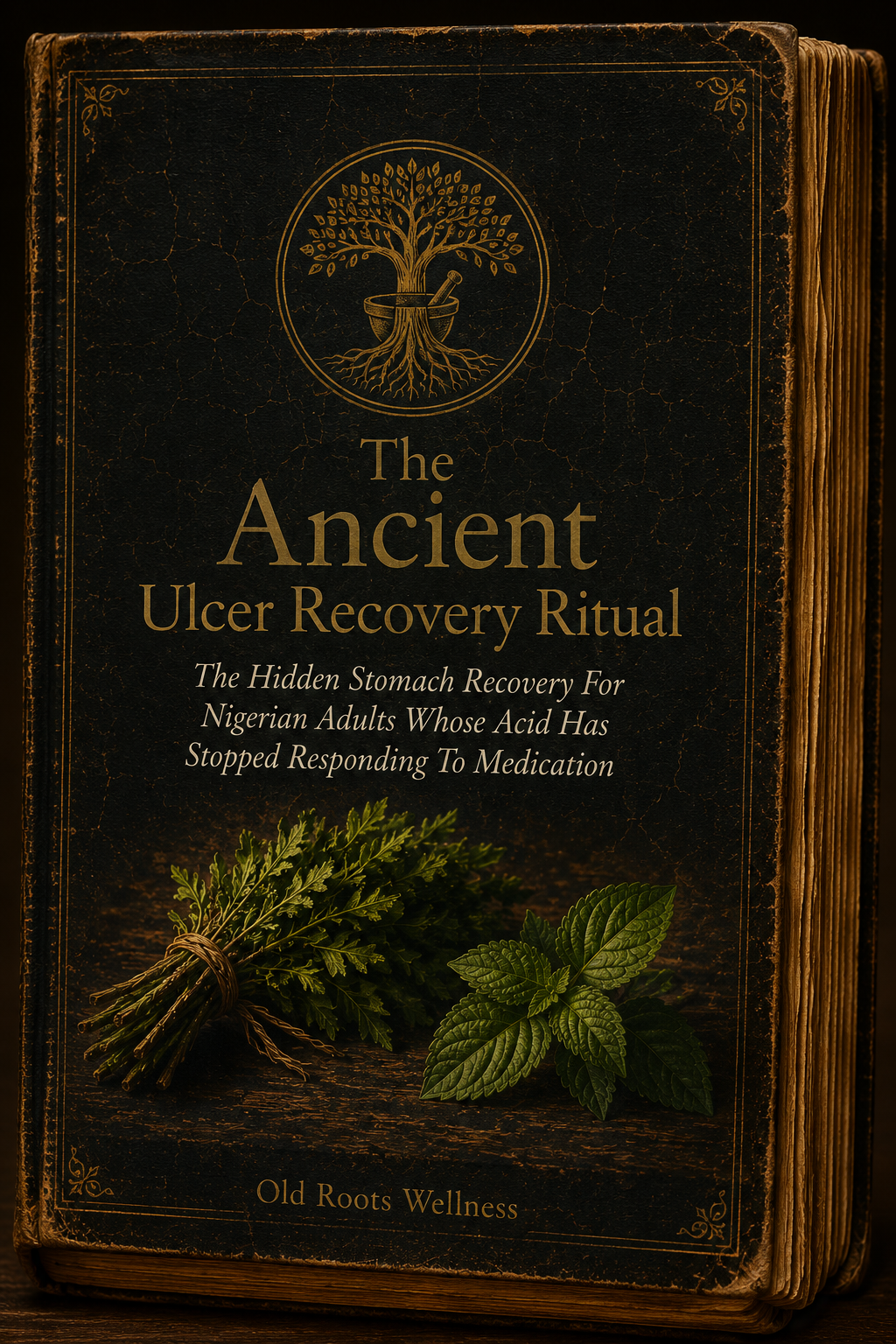
The Ancient Ulcer Recovery Ritual
The hidden stomach recovery for Nigerian adults whose acid has stopped responding to medication
Inside this guide, you will find:
✔ The real reason your ulcer keeps returning — and why acid tablet cycles and antibiotic courses alone will never reach the root of the recurrence pattern
✔ The full forty-year recovery protocol — the specific herbs, the preparation methods, the exact timing relative to your meals, documented in the precise sequence my practice has refined
✔ Where to source every ingredient — all available in Nigerian markets and diaspora African grocers, nothing imported, nothing expensive
✔ The three-phase stomach wall repair sequence — the approach that addresses the active ulcer, the underlying weakness, and the long-term prevention pattern separately
✔ The trigger identification and exit protocol — how to know which triggers are permanent and which are temporary, and the structured process for reintroducing foods without risking a flare
✔ The stomach environment protocol — what traditional Nigerian herbs do to the conditions the bacteria needs to survive, in plain language without clinical terms
✔ The long-term maintenance ritual — the simple ongoing practice that keeps the stomach wall strong so the recurrence cycle does not restart
A note of honesty from Papa Chijioke
This is a natural, supportive lifestyle protocol built on traditional Nigerian plant preparations, dietary sequencing, and stomach environment management. Many adults find it helps reduce recurrence and restore comfortable digestion. It is not a drug, a medical procedure, or a substitute for clinical care.
If your symptoms are severe, include bleeding, significant weight loss, or persistent vomiting, please see a doctor immediately. Peptic ulcer disease can have serious complications that require clinical management. This guide supports your recovery alongside medical care, not instead of it.
This protocol works best for adults experiencing recurring ulcer symptoms or chronic stomach discomfort who have already completed or are completing medical treatment and want to address the underlying recovery pattern.
Something Extra Before You Decide...
The Ancient Ulcer Recovery Ritual addresses the stomach directly. But in forty years of practice, I have been clear about something.
The stomach does not exist in isolation. Two things consistently undermined recovery in every patient I worked with over those years.
So today, alongside the main guide, I am including two additional protocols that address what the main ritual cannot cover alone.

- The family-tested herb and fruit combination that Nigerian elders used to eliminate post-meal bloating and indigestion from the inside out
- Why bloating and ulcer conditions share the same underlying stomach environment — and why addressing one without the other leaves the recovery incomplete
- The 21-day digestive rhythm protocol — the daily sequence that restores normal digestion without pharmaceutical enzyme dependency
- Foods that support digestion versus foods that quietly stall it — specific Nigerian dietary patterns mapped for the recovering stomach
- The cross-system maintenance schedule — how to run both recovery protocols simultaneously without conflict
- Why chronic work and financial stress is one of the most overlooked drivers of ulcer recurrence in Nigerian adult men aged 30-55 — and the mechanism behind it
- The traditional Nigerian stress-regulation practices that reduce the body's acid response to pressure — documented in the old knowledge my practice has preserved
- A simple daily practice that takes under ten minutes and demonstrably changes how your stomach responds to stress triggers
- Warning signs that your recurrence pattern is stress-driven rather than dietary-driven — and the different protocol approach each requires
- How to build the stomach-protective daily rhythm that Nigerian elders maintained without knowing the clinical language for what they were doing
Both bonus guides are delivered instantly alongside the main protocol. No extra cost. No extra steps.
Nigerian Adults Who Have Used This Protocol
What This Costs
Let me be direct with you.
The average Nigerian adult with a recurring ulcer condition spends between ₦8,000 and ₦15,000 monthly on acid tablet cycles, probiotic supplements, and specialist visit fees. Every month.
Over a year, that is between ₦96,000 and ₦180,000 on management that does not reach the root of the problem.
A fair price for a complete at-home recovery system that addresses what those monthly expenses cannot would be ₦19,800. That is still less than two months of the average Nigerian ulcer management spend.
But I want this protocol to reach every Nigerian adult who needs it. So here is what you are getting today:
Everything in the package:
All 3 guides • instant digital download • lifetime access
🔒 Secure payment • Instant access • 60-day money-back guarantee
₦5,800 is the launch price for this protocol. Once the launch window closes, the price returns to ₦19,800 and the bonus guides will no longer be included. If you are ready, this is the right time.
🛡️ 60-Day Recovery Guarantee
Here is how it works:
Step 1: Get all three guides today.
Step 2: Follow the Ancient Ulcer Recovery Ritual for 30-45 days as the protocol instructs.
Step 3: Track your stomach responses — hunger pain frequency, post-meal discomfort, trigger sensitivity.
If you do not notice meaningful improvement in your stomach symptoms within 60 days of consistent use, send a message and I will refund your ₦5,800 in full. No difficult questions. No delay.
The only risk here is continuing to cycle through acid tablets that will wear off again next month.
Two Directions From Here
Buy another pack of acid tablets next month.
Continue avoiding the foods you have quietly removed from your life one by one.
Continue the anxiety of waiting too long between meals.
Continue the cycle that has been running for years without resolving.
The stomach environment does not repair itself without deliberate intervention. Management is not recovery.
Imagine six weeks from now...
The hunger pain that woke you before your alarm is gone.
You eat a full Nigerian meal without bracing for the aftermath.
You travel, work, attend events, without planning your day around your stomach.
Your monthly pharmacy spend on antacids drops to zero.
This is what recovery looks like. Not management. Recovery.
Questions People Ask Before Getting The Protocol
One Last Thing Before You Go
Imagine it is six weeks from now.
It is a Sunday. There is a full meal on the table. Jollof rice. Fried plantain. The soup your body has been rejecting for three years.
You sit down.
You eat.
You finish.
And then you wait.
And nothing happens.
No burning. No fear. No reaching for the antacid pack in your pocket.
Just a Sunday meal, like every Sunday meal should feel.
That moment exists on the other side of a decision you can make right now.
The knowledge that produces it has existed for generations. I have spent forty years watching it work. What I have done here is document it in the structured form that a modern Nigerian adult can actually use at home.
It is waiting for you.
To your complete recovery,
Papa Chijioke
Traditional Herbalist • Old Roots Wellness
P.S. — The 60-day money-back guarantee means your only risk is continuing to do what has not been working. Either the protocol recovers your stomach health or you receive your ₦5,800 back. No delay, no difficult questions.
P.P.S. — ₦5,800 is the quiet launch price. Once this window closes, the price returns to ₦19,800 and the two bonus guides will no longer be included at no cost. If you are ready to address the root of the recurrence pattern, this is the time to begin.
P.P.P.S. — Every month you spend on another acid tablet cycle is another month of management. The stomach environment that allows the ulcer to keep returning does not repair on its own. The protocol that addresses it is ₦5,800. The math is not difficult.